


People See My Body and Think They Know Me


Some days it feels like fat people can't simply exist in the world without having assumptions made about them.
Walk into a gym and people assume you're there because you're trying to lose weight. Order a salad and someone comments that you're "being good." Order a burger and suddenly everyone becomes a nutrition expert. Go to the doctor with a sore throat, a knee injury, or a migraine, and somehow the conversation circles back to your body size before anyone has taken the time to ask meaningful questions.
The truth is, many of us are tired. Not because we're fat, but because we're constantly navigating other people's assumptions.
One of the most persistent stories society tells about fat people is that we're lazy. Closely tied to that is the belief that we're unmotivated, undisciplined, or somehow less capable than people in smaller bodies. These stereotypes have been around for so long that many people accept them as fact without ever stopping to question where they came from or whether they're actually true.
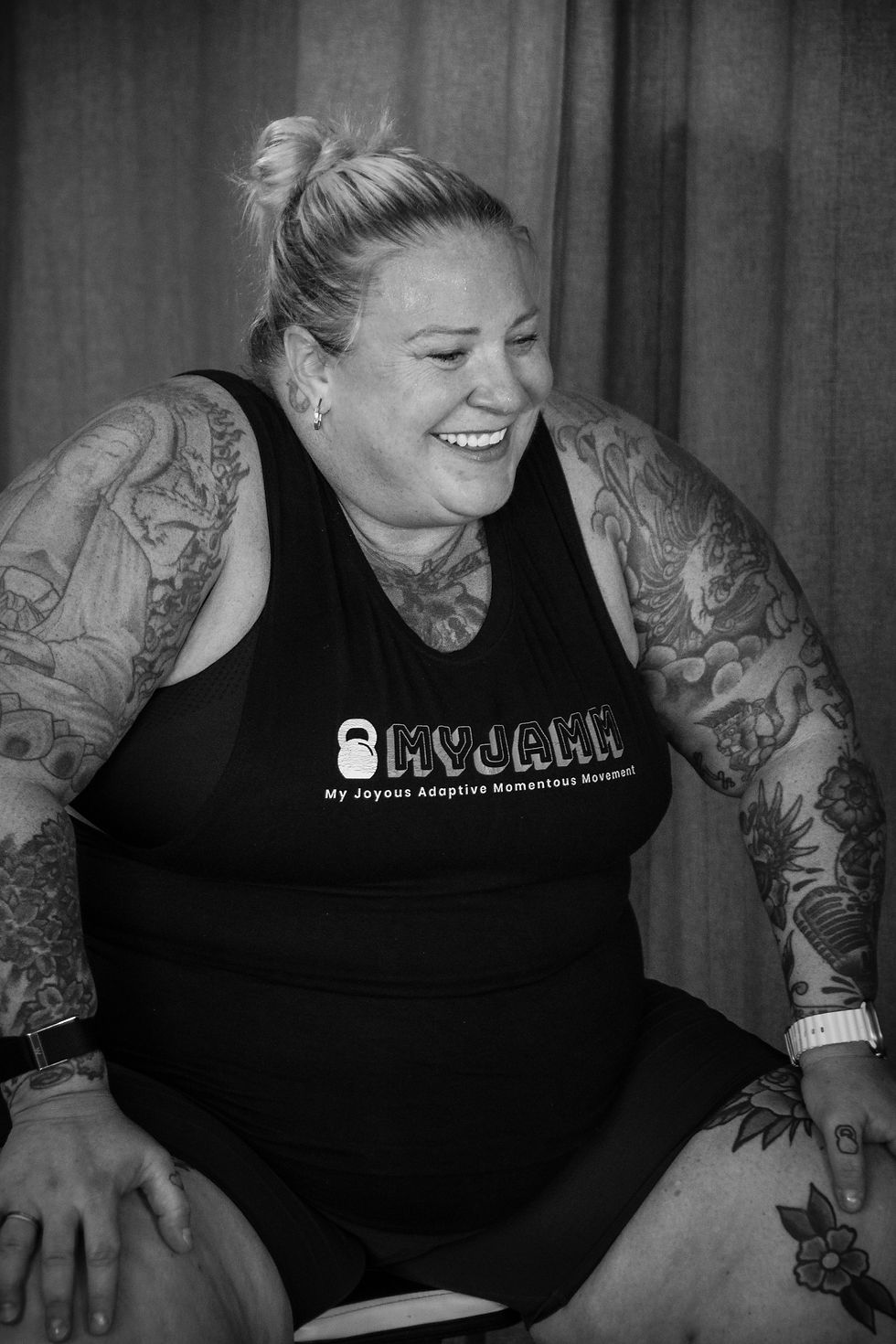
As someone who lives in a fat body and has spent years coaching people from all walks of life, I can tell you that body size tells you far less about a person than most people think.
Earlier this year, I stood on a national platform at Masters Nationals surrounded by incredible athletes who had dedicated years to their sport. I belonged there just as much as anyone else. I train multiple days a week. I coach. I run a business. I volunteer in my community. Yet I know there are people who could look at a photo of me and immediately assume I'm lazy or that I don't work out.
That's how powerful these stereotypes are.
People will often believe a story they've been told about fat bodies before they'll believe what's right in front of them.
What makes that so exhausting is that fat people are constantly expected to provide evidence to the contrary. We have to prove we're active. We have to prove we're knowledgeable. We have to prove we're capable. We have to prove we're disciplined enough, productive enough, or successful enough, as though our humanity is something that needs to be earned instead of something we already possess.
I've spent years being underestimated because of my body size, only to have people completely change their assumptions once they learn I'm a coach, a business owner, or a competitive athlete. What strikes me is that I was the same person before they knew any of those things. The only thing that changed was their perception of me.
What I find interesting is that we rarely question our assumptions when we see someone in a smaller body. We don't immediately wonder how often they exercise or whether they're disciplined enough. We don't assume they're lazy because they spend a weekend relaxing or decide to skip a workout. Yet fat people are often subjected to that scrutiny every single day.
Somewhere along the way, many of us started believing that body size tells us something about a person's character. We assume larger bodies mean someone isn't trying hard enough and smaller bodies mean they're disciplined and successful. We make these snap judgments without ever stopping to ask whether they're true.
Real life tells a very different story.
I think about the people who reach out to me for coaching. Most of the time they aren't worried about whether they're capable of moving their bodies. They're worried about whether they'll be judged. They're worried about whether they'll belong. They're worried that someone is going to look at them and make assumptions before they've even had a chance to introduce themselves.
And honestly, after the experiences many people have had, I understand why.
So many people have been made to feel like fitness isn't for them. They've been told they need to change their body before they're welcome in a movement space. They've worked with coaches who focused on their size instead of their goals. They've been treated like a problem to solve instead of a person with strengths, challenges, experiences, and dreams that matter.
Then we act surprised when people are hesitant to reach out for coaching or walk into a gym.
The question isn't why people are reluctant.
The question is why we've made so many spaces feel unsafe in the first place.

One of the reasons I started My JAMM was because I was tired of seeing people walk into fitness spaces already apologizing for themselves. I was tired of hearing stories from people who had been shamed by coaches, ignored by healthcare providers, or made to feel like they had to shrink themselves before they were worthy of support.
I wanted to create something different.
I wanted a place where people could show up exactly as they are. A place where movement wasn't a punishment and where no one had to earn their right to participate. A place where people could build strength, confidence, and community without being told their worth was tied to the size of their body.
Over the years, I've watched people walk through the door convinced they didn't belong. I've watched people apologize for their bodies before we've even started a conversation. I've watched people assume they would be the slowest person in the room, the least athletic person in the room, or the person everyone else would be watching.
And more often than not, what they needed wasn't a better workout program.
What they needed was a space where they felt welcomed.
A space where they weren't judged before they even began.
The irony is that many fat people spend their lives adapting to spaces that were never designed for them. We navigate seats that don't fit comfortably, clothing stores that don't carry our sizes, healthcare systems that often dismiss our concerns, and fitness spaces that assume we don't belong. Yet despite all of that, society continues to label us as lazy. If anything, many fat people are carrying an extra layer of labor that smaller-bodied people never have to think about.
The barrier is rarely what other people think it is. More often, it's the years of shame that have been piled onto someone by a culture that constantly tells them they're not enough. It's the fear of being judged before they've spoken a word. It's the exhaustion that comes from feeling like they have to prove themselves over and over again just to be treated with the same respect that others receive automatically.
I wish more people understood that fat people do not owe anyone an explanation. We do not have to explain what we eat, how we move, what our health history is, or why our bodies look the way they do. We should not have to earn respect by proving we're active enough, disciplined enough, or productive enough.
What gets me is that nobody really knows what another person is carrying.
The person you assume is lazy may have just worked a ten-hour shift. They may be caring for aging parents, navigating chronic pain, dealing with grief, raising children, managing a disability, or simply trying to make it through a difficult season of life. They may have spent years convincing themselves to walk into a gym or reach out to a coach because they've been told over and over again that movement spaces aren't meant for people who look like them.
The truth is that we know very little about people from looking at them, yet when it comes to fat bodies, many people still believe they can tell everything they need to know.
I've spent years coaching people in all kinds of bodies and all kinds of circumstances. I've watched people do incredibly hard things while carrying burdens that nobody else could see. I've watched people rebuild trust with their bodies after years of shame. I've watched people discover strength they didn't know they had because someone finally created a space where they felt welcomed instead of judged.

That's why this conversation matters to me.
Not because I'm trying to convince anyone that every fat person is an athlete. Not because I'm trying to prove that every fat person exercises. And certainly not because I believe fat people should have to earn respect by demonstrating how productive, strong, or active they are.
The point is that none of those things should determine whether someone deserves dignity in the first place.
Maybe that's what I wish people understood most.
Fat people are not asking for special treatment. We're asking people to stop assuming they know our story before we've had a chance to tell it.
We're asking to walk into a doctor's office and have our concerns taken seriously. We're asking to enter a gym without being treated like a before picture. We're asking to apply for jobs, move through public spaces, shop for clothes, and exist in our communities without having our bodies become the first thing people judge.
We're asking for the same respect, dignity, and humanity that people in smaller bodies are given every day.
Because the truth is, you cannot tell someone's character, work ethic, resilience, kindness, or worth by looking at their body. You never could.
What you can do is choose curiosity over assumptions. You can choose to listen instead of judge. You can choose to see people as whole human beings rather than reducing them to the size of their body.
And honestly, I don't think that's asking for too much.


Comments